September 6, 2026 Report – Darfur24
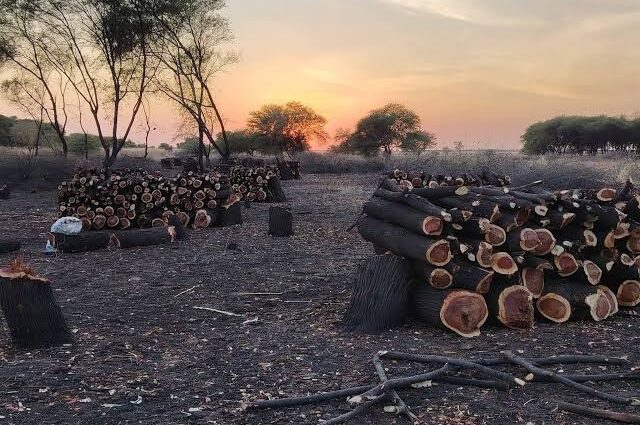
The expanding deforestation in the Darfur region of western Sudan is not limited to environmental degradation and soil loss; it also extends to the loss of natural grazing lands for livestock and an increase in drought-stricken areas, raising fears of renewed conflict between herders and farmers.
The effects of deforestation, driven by the use of wood for cooking fuel and the booming charcoal trade, have manifested in the drought that has afflicted vast areas of farmland across Darfur.
In light of the accelerating decline in tree cover, the Darfur24 podcast provided a platform for experts to discuss the impacts of rampant deforestation on people, livestock, and the environment.
Sudanese environmental expert Bushra Hamid Ahmed stated that the environment, nature, and vegetation in Darfur are fundamental to the social and economic life of its citizens. He added that Darfur region is the second largest source of livestock in Sudan, which depends primarily on the availability of grazing lands, water, and a suitable environment.
Bushra pointed out that the “gum arabic belt”in Darfur covers a vast area, yet the state has not made sufficient efforts to develop it and maximize its benefits for supporting local producing communities and improving their incomes from gum arabic production, despite the fact that “trees, forests, and water are the lifeblood of the people of Darfur.”
Hamed Ahmed explained that numerous studies have linked the occurrence of security problems and increased tensions in the region to environmental factors, particularly desertification and the encroaching drought southward.
Bushra criticized what he described as the “prevailing understanding” in Sudan regarding deforestation, stating that there is a general belief that cutting down trees is permissible and does not warrant accountability, coupled with weak law enforcement mechanisms, even among some of those responsible for its implementation.
He clarified that the strategies developed to combat deforestation came too late and were not implemented effectively. Meanwhile, internal displacement has driven some displaced people to encroach on forest areas and cut down trees to provide for their families’ basic needs, given the lack of alternative sources of income.
Climate Change:
Bushra Hamed Ahmed stated that some individuals lost their money , jobs and other sources of income due to the war, but amassed considerable wealth through deforestation, becoming obscenely rich at the expense of millions of lives, without any apparent concern from the authorities.
He explained that if 20 million acres were cleared, with an average annual investment of $1,000 per acre, the losses would reach approximately $20 billion. He argued that this sum could have covered the entire national budget and called for these losses to be included in reconstruction and rehabilitation process in any future peace negotiations.
Bushra warned that rising temperatures are no longer a temporary issue but have become a permanent phenomenon unless vegetation is restored. He explained that forests play a crucial role in stabilizing the soil, and that deforestation exposes trees to erosion , leading to soil erosion and loss of biodiversity.
He pointed out that rising temperatures are a consequence of the degradation of vegetation cover, indicating that planting one million trees could reduce the temperature by one degree Celsius.
He emphasized that biodiversity is essential for life, noting that deforestation threatens this diversity and lead to the extinction of many animals. He pointed out that human presence in any environment must be based on balance and avoiding the exploitation of natural resources beyond the environment’s capacity for regeneration.
He added that some communities have begun to feel the effects of environmental degradation as its impact on their lives becomes increasingly apparent. He warned that the financial gains from deforestation cannot be compared to the losses inflicted on the community and the economic and social life of the region.
Vanishing Forests:
Agricultural engineer Abubakr Yaqoub stated that the Kandwa Forest in South Darfur was once a large forest and a popular tourist destination, but it has disappeared due to rampant logging following the establishment of the Kalma camp for internally displaced persons (IDPs) nearby. IDPs resorted to cutting down trees for firewood and charcoal.
He explained that Central Darfur also lost a forest located north of Zalingei, which contained various tree species. According to him, it disappeared due to the absence of law enforcement, leading to its complete destruction.
Abubakr revealed that the Central African Republic is now classified as an exporter of gum Arabic, despite not having any acacia trees in the country. He pointed out that its exports rely on gum Arabic from western Sudan, given the Central African Republic’s proximity to Central and South Darfur states.
Environmental sit-in:
Agricultural engineer Ibrahim Al-Mahdi Zakaria, one of the organizers of the 2021 sit-in in the Um Zaifa area of South Darfur, said that the sit-in was a protest against rampant logging and the encroachment on forests.
Al-Mahdi expressed his deep regret over the environmental situation in Sudan, criticizing what he described as official and public neglect, as well as the neglect of state institutions and successive governments regarding environmental issues.
He stated that citizens were a major part of the problem of environmental degradation due to a lack of awareness, noting that forest cover in Sudan was approximately 30 percent before the secession of South Sudan led to the country losing a significant portion of its forest wealth.
Ibrahim al-Mahdi revealed the widespread destruction of the forestry sector as a result of the lack of alternatives and the difficult economic conditions during the war, which forced residents to resort to logging and rely on forest products for their livelihoods.
He affirmed that Ed Alfursan Youth Forum for Development and Peaceful Coexistence in South Darfur State organized the first environmental sit-in in March 2021, considering the move a powerful message and a “huge alarm bell” regarding the systematic destruction of the environment.
He stated that the fundamental problem facing environmental issues lies in the weak official attention from government institutions, coupled with a lack of awareness among citizens and officials regarding environmental matters and the failure to enforce laws. He called for intensified efforts and greater focus on environmental issues.
The War Exacerbates the Forest Crisis:
For her part, agricultural engineer Marwa Omar from the Ministry of Agriculture in South Darfur said that the forestry sector was already facing problems before the war due to indiscriminate and excessive logging and the removal of vegetation cover. However, the April 15th war significantly exacerbated the crisis.
She explained that the shortage of cooking gas was one of the main reasons that led residents to rely almost entirely on forests. She pointed out that the smuggling of charcoal to neighboring countries further complicated the crisis, especially in the absence of oversight.
She added that the neem forest in Nyala has become almost nonexistent, warning of the environmental, economic, and social repercussions, including desertification, soil erosion, and disruption of the local water cycle.
She added that the absence of vegetation reduces atmospheric humidity and transpiration rates, noting that trees contribute to increased humidity and a more temperate climate. She explained that the deterioration of vegetation cover can disrupt rainfall patterns and lower groundwater and surface water levels.
She pointed out that residents have complained this year of high temperatures, which she considers an indicator of the lack of vegetation.
She stated that Darfur has a poor savanna climate, which gives the region unique plant characteristics, along with the Kordofan region, both known for producing gum arabic trees, a vital natural ecosystem resource.
She emphasized that the destruction of gum arabic trees leads to the loss of biodiversity and plant life, and contributes to the reduction of grazing areas and the depletion of fertile agricultural land, potentially leading to conflicts between farmers and herders.
She noted that logging has become an additional burden on women and children, who are forced to travel long distances to collect firewood, exposing them to the risk of harassment amidst the widespread proliferation of weapons.
Alternatives to Reduce Deforestation:
Marwa emphasized that solutions require providing energy-saving stoves that reduce firewood and charcoal consumption, along with changing tree management practices to pruning rather than uprooting trees, allowing the remaining parts to regenerate.
She called for recycling agricultural waste and producing biochar from peanut shells, corn stalks, and animal dung, considering this an alternative that can reduce pressure on forests.
She concluded by saying that the efforts required from the Ministry of Forestry after the end of the war will be “enormous,” given the extent of the deterioration the forestry sector has suffered in recent years.