September 23, 2026 Report – Darfur24
Along the border between Sudan and the Central African Republic, political lines drawn on maps appear insufficient on their own to halt the movement of herders, prevent friction between populations, or resolve long-standing conflicts that reignite whenever state mechanisms are absent.
In the twin areas of Um Dafuq (Sudan) and Um Dafuq (Central African Republic), grazing and trade routes intersect with the complexities of war, the proliferation of arms, and a weak official state presence. communities living alongside the border find themselves in a statement highly sensitive dilemma: how to maintain a historic pattern of coexistence and cross-border pastoral movement at a time when the state’s capacity to protect borders and enforce the law is in decline.
In recent years, border areas have been subjected to armed attacks that resulted in fatalities that forced residents to flee, and directly impacted relations between border communities. Meanwhile, reconciliation conferences and traditional administrative bodies have attempted to contain tensions and prevent them from escalating into broader confrontations.
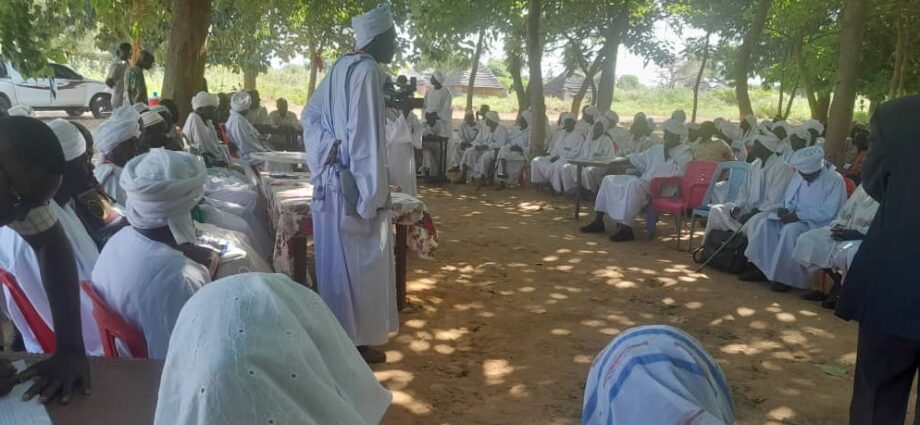
The most recent of these efforts was a conference held in June 2026—following an earlier one in October 2025—aimed at restructuring the relationship between Sudanese herders and local residents in the Central African Republic. These conferences sought to renew prior commitments regarding blood money (diya), pastoral movement, the carrying of weapons, and respect for the host state’s laws.
However, a renewed armed attack shortly after the June conference raised fresh questions about whether reconciliation conferences alone can resolve a conflict intertwined with tribal, security, and economic factors that transcend national borders.
Um Dafuq A Gateway for Grazing and Trade
Located… Um Dafuq is located in the southwestern part of South Darfur State and serves as one of the key border areas between Sudan and the Central African Republic.
Veterinarian Dr. Ahmed Saleh Ali Abu Duraa tells the “Darfur24 Podcast” that the region boasts significant livestock wealth, water resources, and vast farmlands, while also serving as a gateway from Sudan into the Central African Republic.
According to Dr. Abu Duraa, the region’s importance stems from its status as part of a historic pastoral route; Sudanese herders have long driven their livestock into Central African territory in search of water and pasture—a journey that can span more than nine months of the year.
He notes that this pastoral pattern is difficult to alter, given the abundance of natural resources on the Central African side compared to what is available to herders within Sudan.
Abu Duraa believes that addressing the issue cannot be achieved simply by prohibiting border crossings; rather, it requires projects that foster stability for herders and provide water and grazing lands within Sudan.
An Old Dispute and a New War
According to Abu Duraa, tensions began as localized disputes within the Central African Republic in 2022, stemming from friction between herders arriving from Sudan and the settled populations in border areas.
The parties to the conflict, according to these accounts, include groups from the Sara and Kara tribes in the Central African Republic, alongside the Ta’aisha, Misseriya, and herders from other Sudanese tribes who cross the border in search of resources. However, the outbreak of war in Sudan further complicated the situation by weakening state institutions and creating greater freedom of movement for armed groups and outlaws.
Furthermore, the joint forces that previously maintained security along the borders between Sudan, the Central African Republic, and Chad have withdrawn, leaving a security vacuum across a vast, sprawling region.
Attacks Force Population Displacement
Recent attacks on the Central African town of Am Dafok have had a direct impact on the local population and pastoral activities. Abu Dhiraa states that the attack triggered the displacement of large numbers of Central African residents into Sudanese territory, while raising concerns that the fallout could prevent Sudanese herders from entering the Central African Republic during the upcoming grazing season.
He believes that the continuation of this situation could affect the local economy on both sides of the border; pastoralism is not merely a means of livelihood but a fundamental component of trade and exchange across all aspects of life for these border communities. According to reports, the death toll from recent conflicts exceeded 28 people from both sides—a figure that reflects the magnitude of the risks facing local communities if the root causes of the conflict are not addressed sustainably.
Sudanese Refugees in the Central African Republic
In October 2025, a reconciliation conference was held between the relevant parties from the two neighboring countries. According to Issa Moussa Issa—a resident of Um Dafuq, Sudan—the conference helped facilitate the movement of herders and significantly reduced incidents of theft and looting.
Issa notes that the conference enabled herders to move more smoothly between Sudan and the Central African Republic and helped curb looting and theft. However, the reconciliation agreements later faced implementation challenges, particularly regarding the payment of blood money and the fulfillment of security obligations.
In June 2026, a new conference was held to renew previous commitments and resolve several outstanding issues.
Abu Duraa states that the June conference was not separate from the October one; rather, it aimed to revitalize the outcomes of previous conferences and urge the parties to adhere to them.
However, an armed attack occurring just days after the conference exposed the fragility of the security situation, raising questions about whether tribal agreements alone are sufficient to deal with attacks that may extend beyond the traditional parties to the conflict.
Blood Money…An Obstacle to Reconciliation
The issue of blood money (diya) has been one of the most complex aspects of implementing reconciliation agreements. According to reports, a prior agreement stipulated the payment of approximately 99 million Sudanese pounds in blood money; mechanisms and committees were established to collect these funds from Sudanese herders present in the Central African Republic.
However, according to Abu Dhiraa, these mechanisms faced violations during the collection process, which delayed the payment.
The significance of this issue lies in the fact that failure to meet financial obligations is not merely a legal or tribal matter; it can become a direct cause for restricting the movement of herders and closing borders.
Abu Dhiraa warns that the border could be closed this coming November if herders fail to honor their commitments regarding blood money and the signed agreements.
Weapons…Protection for Herders or Fuel for Conflict?
One of the most contentious issues is the carrying of weapons by Sudanese herders while within the territory of the Central African Republic. (Omda )(Tribal Chief) Suleiman Mohammed Jaber states that the reconciliation conference outcomes mandate that the Baggara herders refrain from carrying weapons inside the Central African Republic and respect the laws of the host country.
However, Abu Duraa offers a different perspective on the practice of carrying weapons, noting that security control is weak in certain border areas and that some herders carry arms to protect themselves and their livestock from outlaws.
Traditional Administrations…. A Substitute for the State?
As the presence of state institutions has waned, traditional administrations have emerged as key players in managing border conflicts. Abu Dhiraa states that traditional administrative bodies currently play a pivotal role in containing crises, citing reconciliation conferences that have successfully addressed various issues, scheduled blood-money payments, and renewed agreements.
He also notes that the leadership of the Ta’aisha tribe—one of the region’s largest groups—possesses social mechanisms that help maintain security. Meanwhile, Sultan Anqabu, according to Abu Dhiraa, is able to influence the Kara tribe within the Central African Republic.
However, despite their social influence, these traditional bodies face clear limitations in enforcing agreements when the region becomes a theater for armed movements that do not fall directly under their authority.
Border Economy Caught in the Conflict
The repercussions of the conflict extend beyond human casualties. Pastoral and commercial activity between the two countries serves as an economic lifeline for border communities; any border closure or restriction on the movement of herders could impact the prices of livestock and goods, the movement of traders, and the livelihoods of thousands of families.
Abu Duraa says that recent events have already affected herding and trade, while the possibility of border closures remains if obligations regarding blood-money payments are not met.
Omda Hamid Al-Hussein Ismail, a representative of the herders, believes that the success of reconciliation conference outcomes also depends on addressing the herders’ basic needs—foremost among them the provision of human and veterinary medicines and water, the opening of migratory routes, and the improvement of security and stability.
Is Grassroots Diplomacy sufficient?
Despite the fragile security situation, people-to-people diplomacy remains a viable tool for fostering communication between border communities.
Abu Dhiraa believes that regional stability cannot be achieved solely through official agreements—particularly given the absence of the Sudanese state across vast stretches of the border—but rather requires sustained interaction between traditional leaderships and various social groups in both countries.
However, the success of this approach hinges on a baseline level of security and adherence to agreements, alongside the presence of official institutions capable of protecting civilians and enforcing the law.
Communities in Need of Peace
The experience of Um Dafuq reveals that coexistence among border communities is not a novel concept; rather, it is a way of life rooted in pastoralism, trade, intermarriage, and cross-border social integration.
Yet, the war, the proliferation of weapons, and the” erosion” of state institutions have rendered this historic pattern increasingly fragile.
While reconciliation conferences have helped alleviate some tensions and open channels for dialogue, persistent attacks demonstrate that tribal reconciliation alone cannot resolve all underlying causes of conflict—especially when local disputes intersect with security vacuums and the movements of armed groups.
Dr. Ahmed Saleh Ali Abu Duraa argues that regional stability requires a dual approach: first, maintaining communication between traditional leaderships and community groups in both countries to preserve the bonds of coexistence; and second, establishing official and security institutions capable of securing the border and enforcing the law. Abu Dhiraa believes that the residents of Umm Dafuq are defending more than just a border line drawn on a map; they are defending a grazing season, a source of livelihood, and a trade route, as well as the social ties that span communities on both sides of the border.
In his concluding remarks, Abu Duraa warns that the failure of this system could have consequences extending beyond human casualties; it could transform the border area from a space of coexistence and exchange into a closed zone dominated by fear, where the grazing land itself becomes a source of conflict rather than a bridge connecting communities.