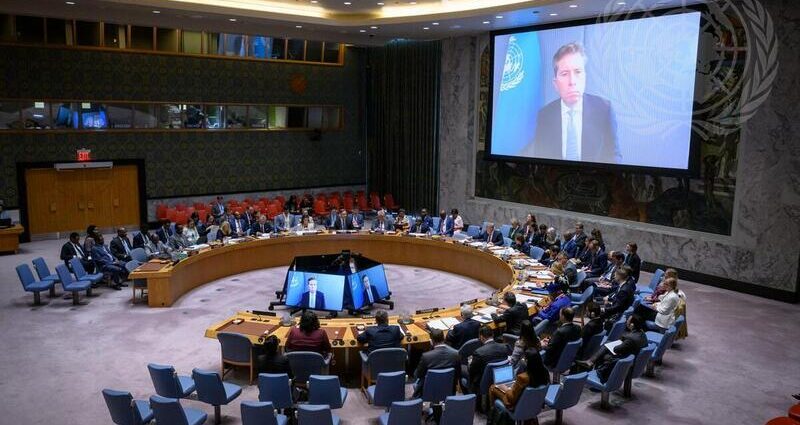
New York, August 25 (Darfur24)
The United States submitted a proposal to the UN Security Council on Monday to expand the arms embargo currently imposed on Darfur to cover all of Sudan.
The embargo, imposed under Security Council Resolution 1591 in 2005 on parties to the conflict in Darfur, is due to expire on September 12 and has been renewed annually without major amendments.
Massad Boulos, senior adviser to the US president on African and Arab affairs, told the Security Council that Washington had submitted a draft resolution proposing the nationwide expansion of the embargo.
The draft would also bring drones and related systems and technologies under the embargo and increase the number of experts serving on the panel established under Resolution 1591.
“These measures do not seek to give any party advantages or disadvantages, or to change the dynamics of the battlefield, except to push for a swift end to the fighting,” Boulos said.
He accused both the Sudanese army and the Rapid Support Forces of prioritizing escalating violence and seeking territorial gains and what he described as an unattainable military victory.
Boulos called on the Security Council to take stronger action to prevent atrocities, ease civilian suffering and hold perpetrators accountable.
“Let me be clear: if this council refuses to act, it is the Sudanese people who will bear the greatest suffering,” he said.
He condemned human rights violations and abuses committed by the RSF, the Sudanese army and affiliated armed groups, calling on all parties to immediately end the violence, protect civilians and commit to a peaceful solution.
Meanwhile, UN Under-Secretary-General for Political and Peacebuilding Affairs Rosemary DiCarlo warned that the consequences of Sudan’s conflict would be long-lasting.
She said 13 million people had fled their homes, including about 8.7 million internally displaced people across Sudan’s 18 states. The UN human rights office documented the killing of around 1,400 civilians during the first half of the year, including about 1,100 killed in drone attacks.
DiCarlo said recent fighting had been marked by the intensive use of drones and limited ground clashes, particularly in areas less affected by the rainy season. Hostilities have been concentrated in North Kordofan, West Darfur, North Darfur and Blue Nile states.
She also expressed grave concern over fighting near the Sudan-Ethiopia border in Blue Nile State.
DiCarlo said the UN continued to support efforts by the Quartet — the United States, Saudi Arabia, Egypt and the United Arab Emirates — to secure a humanitarian truce.
UN humanitarian chief Tom Fletcher said two-thirds of Sudan’s population needed life-saving assistance.
He said aid workers were making every effort to reach people in need despite front lines, drone attacks, insecurity and bureaucratic obstacles.
By mid-year, the UN had reached nearly 11 million people with at least one form of assistance, representing 52% of its priority target. Fletcher said the humanitarian response was on track to reach 11.4 million people with food assistance but was lagging in education, health, shelter and water services.
He welcomed pledges made at the Sudan conference in Berlin in April but said that, with more than two-thirds of the year gone, only slightly more than 40% of the $2.87 billion required for the humanitarian response plan had been received.