Kampala- Darfur24
The war that erupted on April 15, 2023, was not confined to( maps )of territorial control and front lines; it quickly spilled over into markets and the pockets of the population, turning the currency itself into a battleground for sovereign authority between two rival governments.
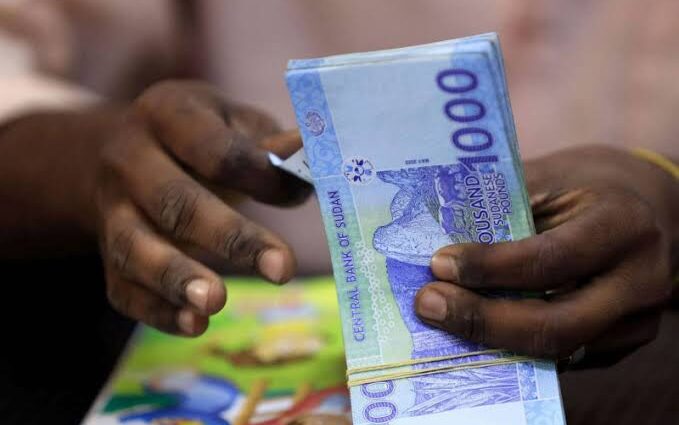
In 2024, the army-controlled government began a large-scale operation to replace certain currency denominations. By May 2026, it had completed a new phase covering the 500 and 1,000-pound notes, declaring that the old banknotes targeted for replacement were no longer valid legal tender in the states that fall under the army jurisdiction
However, the operation did not extend to areas controlled by the Rapid Support Forces (RSF), where the conflict took a completely different turn.
In late May 2026, new banknotes began circulating across vast areas of Darfur and Kordofan. These banknotes bore the date May 2022 and the signature of Hussein Yahya Jangoul—”the former Governor of the Central Bank of Sudan”—coinciding with his appointment as Governor of the central bank established by the “Tas’ees” government of RSF.
Consequently, the pound ceased to be a single, unified currency; instead, a monetary schism emerged, impacting markets and raising fears of broader repercussions for contracts, prices, deposits, savings, and citizens’ rights.
War Economy
Omar Sayed Ahmed, a specialist in monetary crises and the restructuring of financial systems in conflict zones, states that while the situation is partly a response to a liquidity crisis, it simultaneously carries political and sovereign dimensions.
He notes that on May 21, 2026, the “Tas’ees” government in RSF-controlled areas established a monetary council and appointed a central bank governor, saying that the creation of such institutions goes beyond the mere provision of financial services to the construction of tools for economic management. He adds: “Institutions are not measured by their political rhetoric, but rather by the sovereign powers they exercise. This is a political-economic announcement to be interpreted within the context of secession, and an implicit message affirming the continued legitimacy of the pre-coup transitional government.”
Interpreting the move to establish a monetary council and a new central bank solely as a political project overlooks a genuine economic issue; areas controlled by the Rapid Support Forces (RSF) have long suffered from a severe shortage of banknotes after rejecting the new currency issued by the Central Bank of Sudan.
Sayed Ahmed explains that the gap between physical cash in circulation and electronic transfers in areas controlled by the RSF has widened significantly, noting that the discount rate applied when exchanging funds from the “Bankak” mobile app for cash has reached 20–25% in some regions.
Where did the banknotes come from?
The banknotes in circulation bear the date May 2022—predating the war by months—and carry the signature of Hussein Yahya Jangoul, who was the Governor of the Central Bank of Sudan at the time.
The emergence of seemingly new, unused banknotes in the market years after their printing raises two conflicting possibilities: first, that they were recently printed using the old design, specifications, and date; and second, that they are authentic notes that existed prior to the war but remained in storage before entering circulation after being seized from banking facilities or currency printing presses, according to Omar Sayed Ahmed.
Amidst the liquidity crisis, Al-Mustaqbal Bank has emerged as a key instrument for financial transfers and transactions in areas controlled by the RSF.
Sayed Ahmed states that, in his assessment, Al-Mustaqbal Bank does not meet Central Bank requirements or international banking standards, describing it instead as “closer to a quasi-banking platform for digital transfers and transactions.” He points to the absence of requirements considered fundamental to any banking system—such as licensing by a recognized regulatory authority, capital adequacy, liquidity ratios, and leverage, as well as mechanisms for depositor protection and the role of a lender of last resort.
He adds that weak “Know Your Customer” (KYC) protocols and inadequate suspicious transaction reporting could make dealing with such a system high-risk for international financial institutions.
Despite the emergence of “Mustaqbal Bank” in areas controlled by the Rapid Support Forces, the “Bankak” app—operated by the Bank of Khartoum—has remained widely used across areas controlled by RSF.
The Pound Becomes a Risk
A trader in the Nyala market tells Darfur24 “What is happening is unusual activity and a “crazy surge” in prices. Goods imported from South Sudan, and there is a new price every time. You could lose half your capital in just two days.” “The market is stagnant, and many merchants have left it.”
He emphasizes that trade requires cash and that they cannot operate using mobile banking apps; this is why the discount rate for cash versus “Bankak” (mobile banking) transfers has surged to high levels.
He notes that the influx of counterfeit currency into the market has deepened mistrust, forcing traders to use various types of banknotes just to keep business moving.
Another merchant views the problem from a different angle, stating that the danger lies not only in the currency’s value but also in the funds held in accounts; an account could be frozen, effectively forcing the merchant out of the market entirely.
This testimony reveals the core of the issue: in a war economy, losing access to one’s account can be more perilous than the depreciation of the currency itself.
Is Sudan Heading Toward a Two-Tier Pound System?
From an economic standpoint, a monetary split does not require an official announcement; four elements suffice: a currency accepted in one region but not another; a monetary authority issuing the currency or managing its circulation; a parallel banking or financial system; and varying exchange rates based on the zone of control.
Consequently, Sayed Ahmed believes that current events could create a parallel monetary reality, even if the name “Sudanese Pound” remains the same on paper.
The problem escalates if each faction establishes its own exchange rate and pegs prices, salaries, taxes, and trade to the currency it controls.
Sayed Ahmed believes the most dangerous aspect of a monetary split is not the physical banknotes in the market, but the ability of digital funds to the areas of control.
The issue is further complicated by the fact that Sudan entered the war with a banking sector already plagued by deep instability; the banking infrastructure has since suffered looting and destruction, with branches and institutions rendered inoperative across vast areas.