Al-Tina, June 23 (Darfur24)
Thousands of people displaced by recent attacks on villages in North Darfur’s Umbro locality are facing severe humanitarian conditions, with aid workers and community leaders warning of critical shortages of water, food, and shelter in areas hosting those fleeing the violence.
Last week, the Rapid Support Forces (RSF) launched a large-scale assault on villages in the Khazan Urshi area of Umbro locality, northwest of El Fasher, killing and injuring dozens of civilians and forcing thousands to flee toward the border town of Al-Tina and other nearby areas.
According to the International Organization for Migration’s Displacement Tracking Matrix (DTM), field teams estimated that approximately 2,260 people were displaced from the villages of Urshi and Du due to worsening insecurity. The displaced families moved to other locations within Umbro locality as the security situation deteriorated.
However, local leaders and residents say the actual number of displaced people may be significantly higher, with many families scattered across remote areas and beyond the reach of humanitarian assessments.
Eyewitnesses and local sources told Darfur24 that hundreds of residents remain stranded in valleys and forested areas after attacks targeted Khazan Urshi, Baridik, Abu Liha, Bir Maza, and surrounding villages.
Haroun Khater, a community leader in North Darfur, said thousands of displaced people, including women, children, and elderly residents, fled toward Um Haraz after abandoning their homes.
“The area is experiencing a severe shortage of food and drinking water following the arrival of large numbers of displaced people,” Khater told Darfur24. “Urgent humanitarian assistance is needed, particularly for women and children.”
Salah al-Din Ibrahim, who fled from Urshi, said more than 197 families had arrived in Al-Tina, while another 87 families were dispersed across different parts of North Darfur.
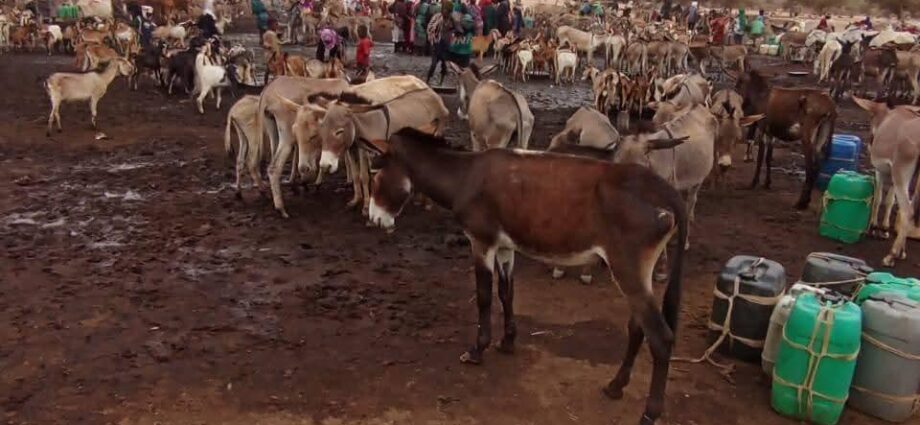
He described dire conditions facing the displaced population, noting that residents and newly arrived families are relying on a limited number of groundwater wells that are also used by livestock.
“You may wait up to 12 hours just to obtain a single gallon of water, especially during the peak of the hot season,” he said.
A volunteer working in the area told Darfur24 that access to clean water and food remains the most urgent priority, warning that humanitarian organizations must intervene quickly to prevent a worsening crisis.
Local responders have called for the immediate provision of water tanks, solar-powered pumping systems, and additional water reservoirs to help meet growing demand. They also urged humanitarian agencies to address lengthy water queues, which residents say can extend for up to two days before families can obtain a gallon of water.
The displacement follows a broader escalation of fighting in northern Darfur. The towns of Karnoi, Umbro, and the border town of Al-Tina remain among the last areas in the Darfur region held by the Sudanese army and allied Joint Force units after the RSF and its allies expanded control over most major cities across the region.