New York, September 22 (Darfur24)
Sudanese civilian forces opposed to the war have urged the United Nations to push for an immediate and comprehensive humanitarian ceasefire, stronger civilian protection and the expansion of the arms embargo to cover all of Sudan.
In a joint letter dated September 22 to the UN Secretary-General and members of the Security Council, the groups called for practical measures to end the conflict and address its humanitarian consequences.
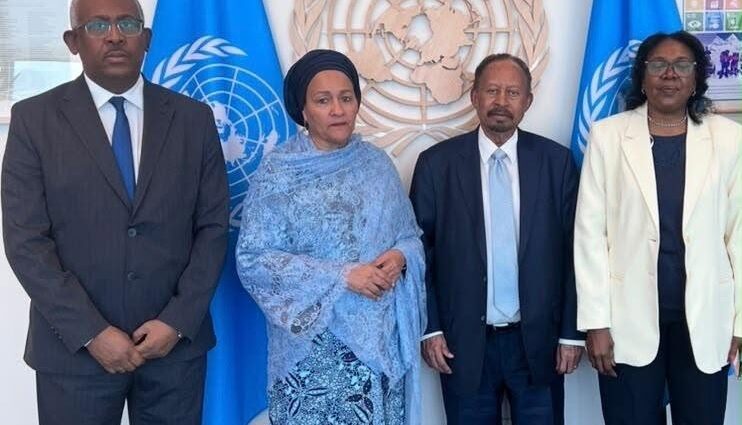
A delegation of Sudanese anti-war forces led by former Prime Minister Abdalla Hamdok arrived in New York for consultations on the sidelines of the UN General Assembly. The delegation met with UN Deputy Secretary-General Amina Mohammed to discuss the war, civilian protection and humanitarian access.
The groups called for an “immediate and unconditional” nationwide ceasefire monitored by an independent mechanism. They also urged targeted sanctions against those obstructing the ceasefire and demanded safe and unhindered humanitarian access across borders and conflict lines.
They called for increased funding for humanitarian operations, support for local responders and assistance for agricultural production. The letter cited a World Food Programme funding gap of nearly $300 million and said the International Organization for Migration requires $15 million to maintain relief operations through the end of the year.
The civilian groups proposed a Sudanese-owned and led peace process on three parallel tracks: humanitarian assistance and civilian protection; a security track focused on a permanent ceasefire and security arrangements; and a comprehensive civilian political process that addresses the roots of the conflict and paves the way for democratic rule.
They also called for international and regional mediation efforts to be coordinated under a single framework combining the Quartet and Quintet initiatives, with clear responsibilities, timelines and joint monitoring.
On arms, the groups urged the Security Council to extend the existing embargo to cover all of Sudan and all parties to the conflict, alongside mechanisms to monitor and verify external military support.
The signatories also urged international institutions not to grant political legitimacy to authorities they described as deriving power from weapons or coups, while maintaining humanitarian engagement with de facto authorities.
They also called for stronger efforts to document violations, preserve evidence, protect victims and witnesses, support the UN fact-finding mechanism and expand the International Criminal Court’s jurisdiction over Sudan.
The groups warned that continued fighting could lead to further loss of life, deepen the risk of Sudan’s fragmentation and expand the conflict beyond the country’s borders.