August 27, 2026 Report – Darfur24
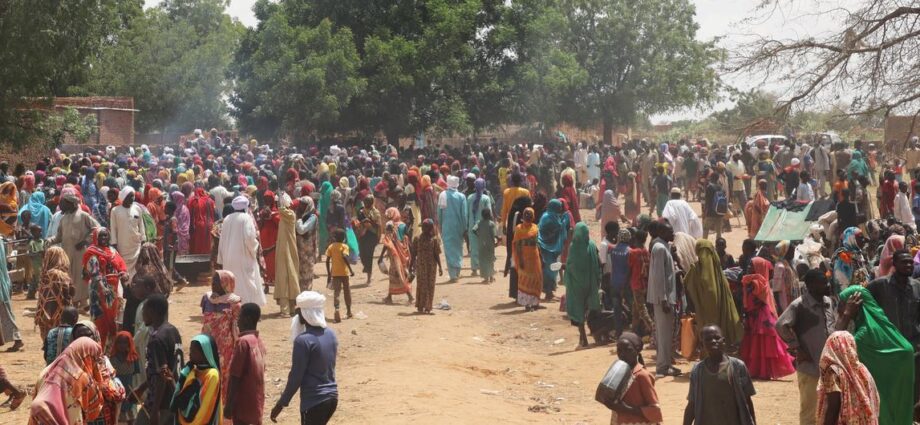
The suffering of Sudanese refugees doesn’t end when they cross internationally recognized borders to escape the war. In refugee camps in eastern Chad, another struggle begins- food shortages, the risks of exploitation, and abuses targeting women. While the influx of those fleeing the fighting continues, the proposed humanitarian truce appears to offer a glimmer of hope to halt the war and pave the way for peace.
The ongoing war in Sudan, which broke out in April 2023, has led to one of the world’s largest displacement crises. Fighting has forced millions of Sudanese to flee their homes, some to other areas within the country, while others have crossed borders into neighboring countries, including Chad, which has received hundreds of thousands of Sudanese, particularly from the Darfur region.
A Sudanese refugee in the Adré refugee camp in Chad, speaking on the Darfur24 podcast, said that the number of Sudanese refugees has increased recently following the flow of new arrivals from various parts of Sudan, noting that the majority of those arriving are from the Darfur region.
The female Sudanese refugee explained that needs within the camps remain significant, particularly regarding food, protection, and medical and health services.
She noted that foreign humanitarian organizations have made considerable efforts to provide services to refugees, but they face a shortage of resources, which limits their ability to respond to the growing needs of refugees.
According to the UNHCR, the number of Sudanese who have crossed into Chad since the outbreak of the war exceeded 941,000 by early August 2026, while more than 935,000 of them have been registered or pre-registered. These new figures are added to the approximately 410,000 Sudanese refugees who were already in Chad before the war began, bringing the total number of Sudanese refugees in Chad to more than 1.3 million, according to the UN.
Sexual Exploitation:
The Sudanese refugee stated that women in the refugee camps face even more difficult circumstances due to limited job opportunities, explaining that some are supporting entire families, making them more vulnerable to exploitation and risks.
The refugee spoke of cases of female refugees who she said had been sexually exploited, including accusations against staff members of Doctors Without Borders. She also mentioned other forms of exploitation faced by women working in homes or on the streets.
In the same vein, a social researcher monitoring the situation of refugees in camps in eastern Chad, speaking on the Darfur24 podcast on condition of anonymity, said she had met one of the women who reported being sexually exploited.
The researcher added that one case resulted in pregnancy and the birth of a child following a sexual assault, according to her account.
She explained that one of the victims reported that an employee of a foreign organization had attempted to sexually exploit her in exchange for aid, noting that she had also been beaten in El Fasher.
In November 2024, journalistic investigations revealed that Sudanese women and girls in camps for internally displaced persons and refugees in Adré, eastern Chad, were subjected to sexual extortion by humanitarian workers and members of local security forces. The United Nations confirmed at the time that the allegations were extremely serious and raised its alert level regarding the risks of sexual exploitation and abuse in Chad, announcing an internal investigation and cooperation with local authorities and human rights organizations.
Last June, the results of an internal investigation by Doctors Without Borders revealed 59 allegations of abuse and exploitation, leading to the dismissal of 18 staff members and their ban from future employment with the organization.
Aid Under the Shadow of War:
Dr. Salah Al-Amin, an independent advisor to several foreign organizations, stated that the Geneva Conventions and the rules governing humanitarian work emphasize the necessity of allowing humanitarian aid access to civilians in conflict zones through safe corridors.
He added that international humanitarian law is not sufficiently respected in Sudan, noting that armed groups treat humanitarian aid as part of the conflict, while some armed groups seek to achieve personal or political gains by controlling aid distribution.
He said that some humanitarian convoys have been targeted or prevented from reaching their destinations under the pretext that they were carrying weapons, arguing that the accusations should not justify targeting convoys or obstructing the delivery of aid to civilians.
He pointed out that the closure of humanitarian aid crossings is not an isolated incident, but rather a pattern that requires serious attention.
Regarding sexual exploitation, Salah said that such violations have occurred in various conflict zones in the past, citing experiences in Cambodia and Liberia.
He called on humanitarian organizations to review the records of their staff before hiring them and to ensure their professional and ethical qualifications, in addition to obligating them to adhere to the regulations and codes of conduct they sign.
He stressed the importance of having clear and secure mechanisms for receiving complaints and investigating any violations, while guaranteeing the protection of victims and witnesses.
For his part, Dr. Idris Yusuf Abdulrahman, an expert in humanitarian work, said that one of the most prominent features of the current war in Sudan is that it erupted within the capital before spreading to other parts of the country, which led to displacement and of large numbers of citizens.
He explained that the war did not only impact the security situation, but also led to the destruction of large sectors of the production , especially agriculture and trade, which paralyzed the ability of families and communities to meet their basic needs.
Idris criticized the classification of civilians in areas controlled by one of the warring parties as being affiliated with that party that control the area they live in, resulting in denial of humanitarian aid.
He emphasized that the provision of aid should be based on humanitarian need, not on affiliation or the region controlled by any party.
He also considered preventing citizens from obtaining official documents, including passports and birth certificates, a violation of their rights, calling for civil services and official documents not to be used as tools in the conflict.
Will the truce become a gateway to peace?
Regarding the proposed humanitarian truce, Salah al-Amin said that the success of any truce depends not merely on its announcement, but on how it is managed and the mechanisms put in place for its implementation and monitoring.
He pointed to a previous humanitarian truce in South Sudan, which he said came after a devastating famine and was reached between the government of Sadiq al-Mahdi and the Sudan People’s Liberation Movement (SPLM) led by Dr. John Garang, with the participation of the World Food Programme (WFP).
He explained that the two sides agreed on a limited humanitarian truce in Northern Bahr el Ghazal, which allowed humanitarian organizations access to the affected population.
He added that the sais truce contributed to creating understandings between the parties to the conflict and enabled the WFP to play a crucial role in delivering aid, as well as paving the way for Operation Lifeline Sudan.
Salah believes this experience can offer a valuable lesson for Sudan, emphasizing the need to consider how to transform any humanitarian truce into a first step towards a comprehensive ceasefire and a political solution to the war.
He stated that the management of the truce is the key factor in determining its success or failure, and that its success requires prior agreements at the highest levels, coordination between the warring parties and humanitarian organizations, as well as the involvement of local communities.
He added that the lack of political will, coupled with the multiplicity of decision-making centers within the warring parties, represents an obstacle to reaching a sustainable truce. He pointed out that there are parties that benefit from the continuation of the war and seek to fuel it, given the proliferation of weapons and the multiplicity of armed groups.