Juba, October 28 (Darfur24)
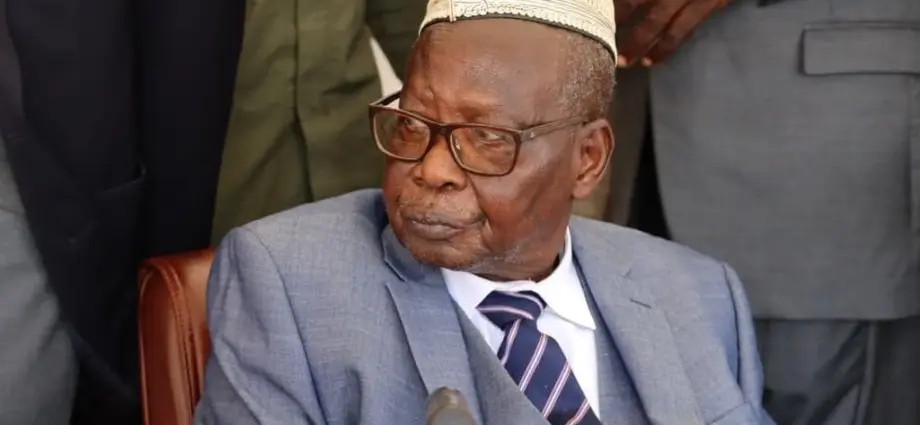
Retired General Joseph Lagu Yanga, a leading figure in southern Sudan’s liberation struggle who helped negotiate the 1972 Addis Ababa Agreement and later served as Sudan’s vice-president and diplomat, has died in Juba at the age of 94.
South Sudanese President Salva Kiir Mayardit announced Lagu’s death on Tuesday, declaring national mourning in honour of the veteran military officer and politician.
Kiir ordered flags across South Sudan and at the country’s diplomatic missions abroad to fly at half-mast until Lagu’s burial. He also said he would personally attend the late general’s state funeral.
“It is with profound sorrow and deep shock that I announce the peaceful passing of His Excellency, Gen. Joseph Lagu Yanga, which occurred this afternoon in Juba,” Kiir said.
The president described Lagu as a nationalist and liberation hero who dedicated his life to the struggle for South Sudan’s freedom. He urged citizens to honour Lagu’s legacy while celebrating his life.
“As his family and the nation mourn his passing, I urge the public to also celebrate his life, because he lived to see the birth of the country he fought for,” Kiir said.
From army officer to liberation leader
Born on November 21, 1931, in Momokwe, in present-day Magwi County, Eastern Equatoria State, Lagu trained as a military officer and joined the Sudanese army after graduating from the military college in Omdurman in 1960.
In 1963, he defected from the army and joined the southern rebellion against the Sudanese government. He subsequently emerged as a central figure in the Anyanya resistance movement during Sudan’s first civil war, which began in 1955.
By 1968, Lagu had become leader of the Southern Sudan Liberation Movement and commander-in-chief of its armed wing, Anyanya. Under his leadership, the movement strengthened its military and political organisation and pursued negotiations to end the conflict.
His most significant political achievement came in 1972, when he signed the Addis Ababa Agreement with the government of Sudanese President Gaafar Nimeiry.
The agreement ended the first north-south civil war and granted southern Sudan regional autonomy, establishing a period of relative peace that lasted until the arrangement was dismantled in 1983.
The agreement also provided for the integration of southern rebel forces into Sudan’s national military and security institutions.
Political and diplomatic career
Following the peace agreement, Lagu returned to the Sudanese army and rose to the rank of lieutenant-general. He later entered public office, serving as president of the High Executive Council of the autonomous Southern Region from 1978 to 1979.
In 1982, Nimeiry appointed him second vice-president of Sudan, a position he held until the government was overthrown in 1985.
The relationship between the north and south deteriorated after Nimeiry abrogated the Addis Ababa Agreement in 1983, ending the region’s autonomy arrangement and contributing to the renewed conflict that followed.
After Nimeiry’s removal from power, Lagu settled in the United Kingdom before returning to public service in diplomatic roles.
He served as Sudan’s permanent representative to the United Nations from 1990 to 1992 and later worked as a roving ambassador for the Sudanese government, a position he held during several periods between 1988 and 1998.
His career spanned the armed struggle, peace negotiations, regional administration, national government and international diplomacy.
Support for South Sudan’s independence
Lagu remained involved in South Sudanese political affairs after leaving senior government positions.
In the years leading up to South Sudan’s independence referendum in 2011, he served as a special presidential adviser to Kiir and supported the south’s pursuit of self-determination.
South Sudan became independent on July 9, 2011, following a referendum in which voters overwhelmingly backed separation from Sudan.
Lagu’s role in the first liberation movement and the peace agreement that granted the south autonomy made him one of the region’s most prominent political figures.
His legacy also reflected the fragility of the peace settlement he helped secure: the 1972 agreement ended one phase of the north-south conflict, but its abrogation in 1983 preceded another prolonged civil war.
Legacy and family
In November 2022, Lagu’s family launched the Joseph Lagu Foundation, an initiative focused on education, leadership development, community empowerment, and humanitarian assistance in South Sudan.
He also documented his life and political career in his 2006 memoir, Sudan: Odyssey Through a State: From Ruin to Hope, recounting his experiences in the liberation struggle, the negotiations that produced the Addis Ababa Agreement and the political developments that followed.
Lagu is survived by his children, including Josephine Lagu, a politician who has served as a vice-president in South Sudan’s transitional government.
His death marks the passing of one of the prominent figures associated with the southern Sudanese struggle for autonomy and independence, as well as a key participant in the negotiations that brought the first civil war to an end.