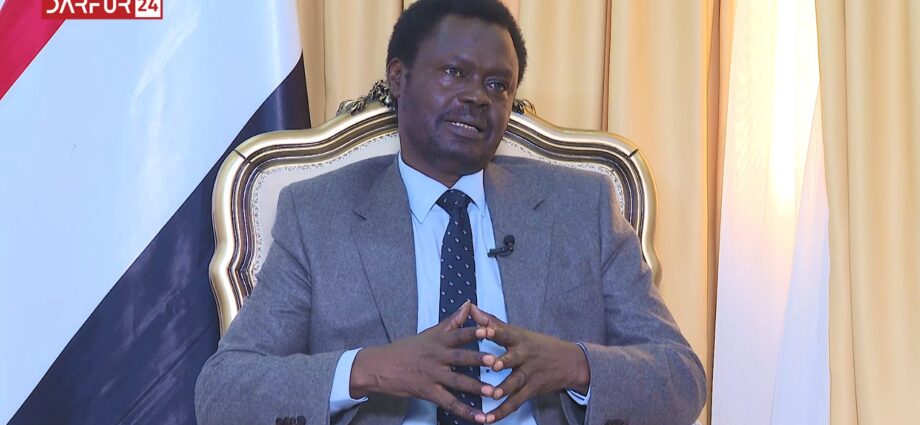
Omdurman, May 18 (Darfur24)
The leader of the Sudan Liberation Movement and head of the Joint Force allied with the Sudanese army, Minni Arko Minawi, said on Sunday that any commander defecting from the Rapid Support Forces (RSF), including its leader Mohamed Hamdan Dagalo “Hemedti,” would be welcomed, while insisting that accountability and justice must still be upheld.
In an interview with Darfur24, Minawi said, “Any defection from the Rapid Support Forces is welcome, even if it is Hemedti, but this does not negate accountability, and justice will have its say.”
He described defections from the RSF as a natural development, attributing them to what he called the absence of a comprehensive national project within the organization, which he described as “strange.”
Recent defections from the RSF have drawn significant attention, including Brigadier General Al-Nur Al-Qubba and prominent field commander Ali Zarqallah, known as “Al-Safna.” Earlier, Abu Aqla Kikil also defected and later fought alongside the army and its allies during the recapture of Al-Jazira State.
Asked about the military significance of these defections, Minawi said: “I don’t know the exact military value, but it’s a convergence of desires.”
Repositioning of Forces
Minawi also addressed the ongoing security arrangements in the capital, stating that efforts to clear Khartoum of military presence would take time, given the recent end of major fighting in the city.
“Khartoum has just emerged from the war, and some military preparations and arrangements are still taking place there,” he said, adding that “it is natural to retain some military trappings.”
Responding to controversy surrounding the redeployment of Joint Forces around Omdurman, Minawi stressed that the Joint Force has long maintained a presence in Khartoum and that the recent movements were not unusual.
“The Joint Force is already present in Khartoum, and redeployment is not unusual,” he said.
Minawi also rejected suggestions of divisions within allied factions, saying Sudan’s increasingly polarized political environment had led competing groups to shape public opinion to suit their own interests.
“There is no disagreement between us in reality,” he added.
Commenting on intermittent clashes between regular forces in markets and public spaces in Omdurman, Minawi described the incidents as accidental and expected under current conditions.
“These incidents are accidental and normal in light of the current situation. We are constantly addressing these issues,” he said.
Markets in Omdurman have recently witnessed sporadic clashes involving security personnel, although police authorities continue to insist that the security situation remains stable and that coordination between forces is ongoing.
Ethiopia, Border Tensions and Military Operations
In response to rising tensions involving Ethiopia and the expansion of RSF operations in the Blue Nile region bordering Ethiopia, Minawi stated that diplomatic efforts remained the preferred path for resolving the crisis.
He argued that the broader military conflict was largely tied to border disputes, whether involving Ethiopia or Chad.
Earlier this month, the Sudanese army accused Ethiopia of allowing its airports to be used as launch sites for RSF drones that targeted Khartoum airport and other locations.
Despite the relative calm on several battlefronts, Minawi revealed that preparations were underway for major military operations, without providing further details.
Ground fighting in the greater Kordofan region has declined in recent weeks, although drone strikes have continued in Darfur, Khartoum and White Nile states.
Position on Political Forces and Truce Efforts
Minawi said the Democratic Bloc, of which he is a leading figure, does not oppose communication with political groups aligned with the opposing side, including the “Ta’sis” alliance, provided they sever ties with the RSF.
The Democratic Bloc recently adopted a comprehensive peace plan during its organizational conference.
He also called on the “Sumud” alliance to adopt what he described as a bolder political stance, stressing that the Democratic Bloc does not serve as a political incubator for the army, but rather “an incubator for the Sudanese cause.”
Minawi reiterated his skepticism toward internationally sponsored truce proposals, warning that any settlement that does not prioritize Sudan’s unity would amount to nothing more than “ink on paper.”
The Quartet mechanism — comprising the United States, Egypt, Saudi Arabia and the United Arab Emirates — has proposed a plan that includes a three-month humanitarian truce, followed by a permanent ceasefire and a political process.
In an earlier interview with Darfur24, Minawi warned that the proposed truce risked creating a Libya-style scenario involving rival governments.