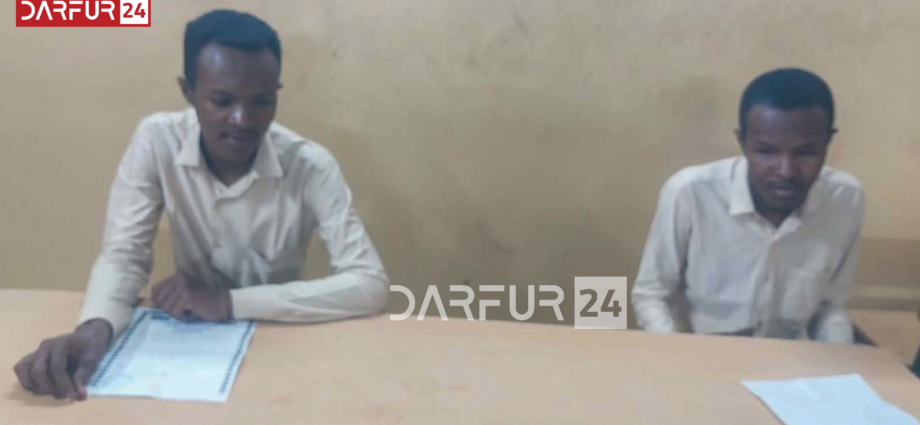
Khartoum, April 20 (Darfur24)
Hassan and Hussein Othman Mani arrived at their examination center with barely an hour to spare.
After 13 days on the road—crossing deserts, checkpoints, and regions fractured by war—the 18-year-old twins from Nyala stepped into a Sudanese Secondary School Certificate examination hall in River Nile State just before their Islamic Education paper began.
“We did not expect to make it,” one of the twins said quietly, recalling the final stretch of a journey that tested endurance, patience, and hope.
The brothers, who are blind, had left South Darfur determined to pursue an education despite a war that has disrupted schooling for millions. Exams this year began last Tuesday, with more than half a million students participating across over 3,000 centers inside and outside Sudan. But entire regions, including Darfur and parts of Kordofan, remain excluded due to ongoing fighting and territorial control by armed groups.
For students like Hassan and Hussein, access to an exam center meant crossing frontlines.
Their sister, who accompanied them, described a journey marked by uncertainty at every turn.
“We paid one million pounds to reach Al-Dabba from the New Reservoir area in East Darfur,” she said. “But when we arrived at Hamra Al-Sheikh, the driver disappeared, so we stayed for more than a week in a hut with a rent of 100,000 pounds.”
Stranded in North Kordofan, the family waited days for a way forward.
“We were told that he had returned to the New Reservoir area, so we had to buy new tickets worth 700,000 pounds,” she continued. “But we again faced problems at the checkpoints because of the ban on young people traveling.”
Movement restrictions imposed by the Rapid Support Forces (RSF) turned the journey into a series of long pauses and negotiations. At one checkpoint, it nearly came to an end altogether—until an unexpected intervention.
“They are blind… let them go,” a soldier reportedly said, allowing the twins to pass.
That moment reopened a path that had repeatedly closed.
The journey resumed through harsh terrain and mounting costs. By the time they reached Ad-Dabba, one day before the exam, the family had exhausted most of their resources. With little money left, they spent the night scrambling to secure transport to River Nile State.
By morning, they were racing against the clock.
Despite the exhaustion, delays, and fear of missing their chance, the twins arrived just in time. Officials completed their registration, and each was assigned a scribe to assist in writing their answers—ensuring they could sit the exam in a stable environment.
For the family, the cost of that moment exceeded six million Sudanese pounds.
But the price reflects more than money. It is tied to years of loss and persistence.
Hussein explained that he and his brother remained committed to their studies even as their lives were flipped. The family lost their father in 2019, and in 2025, their older brother was killed during a looting incident in Nyala as the war spread.
Still, they continued.
“Our family and the school supported us despite everything,” he said.
Their sister believes the journey was worth it—not only for access to the exam hall, but for what lies ahead. She describes both brothers as exceptional in mathematics, adding that their school expects them to rank among the country’s top students.
 For the second consecutive year, River Nile State has hosted displaced students from Darfur, distributing them across designated examination centers. Yet the broader reality remains stark: hundreds of thousands of students in areas outside government control have been unable to sit for the exams at all.
Authorities insist on holding the exams in areas under army control, while regions held by the RSF and the SPLM-North remain excluded. In response, the “Founding Alliance (the parallel government)” has announced plans to organize parallel examinations in June, with registration already underway.
But for Hassan and Hussein, the focus is no longer on politics or competing systems.
It is based on what they have already overcome.
After days in the desert, nights in uncertainty, and years shaped by loss, they made it to their seats—just in time to begin writing a different chapter of their lives.