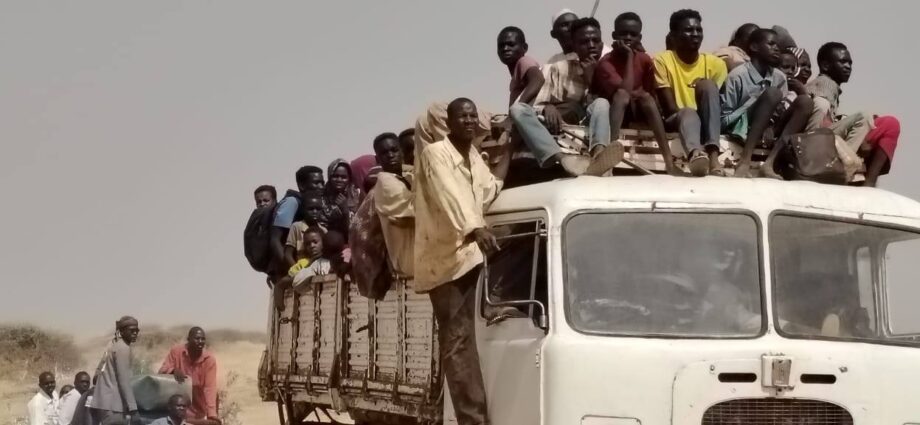
El Fasher, November 26(Darfur24)- Eyewitnesses and local sources in El Fasher, North Darfur State, reported the return of dozens of families to their homes following the Rapid Support Forces’ takeover of the city in late October.
The witnesses told Darfur24 that the city has seen environmental sanitation and maintenance work on several water stations in recent days, in addition to the distribution of relief aid to displaced people in shelters and some neighborhoods.
Saleh Hamed, a volunteer, told Darfur24 that dozens of volunteers came from Nyala and distributed food baskets to displaced people at Darfur Secondary School and the Zain al-Abidin shelters
He indicated that the city’s population exceeds several thousand, including children, women, and the elderly, in addition to a large number of sick and wounded. He confirmed the lack of communication services, while residents continue to return daily, especially to the neighborhoods of Riyadh, Al-Thawra, Al-Tadamun, Al-Ma’had, and Al-Salam.
In a related development, another source, who preferred to remain anonymous, told Darfur24 that a group of El Fasher residents who had previously been displaced to Kutum, Al-Kuma, Mellit, Qallab, Kulqi, Umm Sayala, Mustariha, and Kabkabiya have returned. The source added that some residents of Qarni, Tarra, Al-Kuma, and Kulqi have also returned to benefit from relief supplies.
The source explained that some families have already returned to settle in the neighborhoods of Al-Ziyadiya, Al-Wifaq, Al-Riyadh, Al-Thawra, and Deim Silk, with a partial return to normalcy through the maintenance of water stations, the flow of food supplies, and the limited resumption of operations at El Fasher Teaching Hospital and the Saudi Hospital.
At a press conference in El Fasher on Monday, Ezz El-Din Al-Safi, head of the National Authority for Humanitarian Access in the Sudanese Founding Alliance government, confirmed that the city’s situation is “complex and catastrophic,” with a real food gap. He indicated that conditions remain extremely difficult despite gradual improvement.
Al-Safi stated that the humanitarian aid that has reached the city is sufficient for three months and has been distributed within El Fasher and its surrounding rural areas, noting that more than two hundred volunteers are working to serve the residents, distributing 670 metric tons of aid, including nine items such as sugar, rice, salt, flour, and onions.
He added that five thousand blankets and five thousand tarpaulins were distributed, benefiting 57,000 people, a large portion of whom are in 17 shelters within the city. Aid was also distributed to the areas of Korma, Salunga, and Qarni, and targeted Tabit, Kulqi, Al-Kuma, Umm Kadada, Kutum, and Mellit.
Al-Safi explained that approximately 2,500 people have returned to the city following improvements in services and the security situation, including 1,700 who arrived in a single day. He stated that some basic services have gradually been restored, including the maintenance of four water stations in northern, central, and southern El Fasher, while work is underway to repair the main water station that supplies the entire city.
He also confirmed the provision of two ambulances and the reopening of El Fasher Teaching Hospital, in addition to supplying medicines and medical equipment to the Saudi Hospital.
The Rapid Support Forces captured El Fasher last October after the Sudanese army and its supporting joint force withdrew from the city.