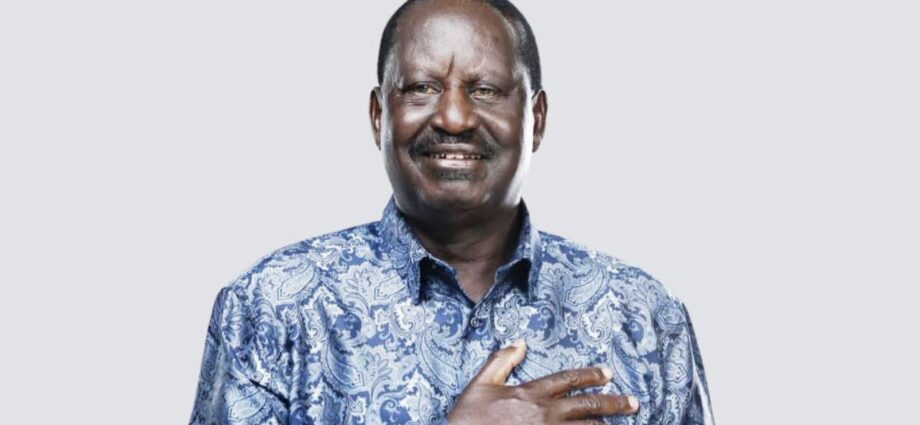
Nairobi, October 15 (Darfur24)
Former Kenyan Prime Minister Raila Odinga has died at the age of 80, the Kenyan Government has announced.
Odinga passed away on Wednesday while receiving treatment at a hospital in India. He reportedly collapsed during a morning walk and was rushed to Devamatha Hospital, where doctors said he suffered cardiac arrest. Despite resuscitation efforts, he was declared dead at 09:52 local time (04:22 GMT).
Following the announcement, President William Ruto, in a televised address, extended his condolences to Odinga’s family, his party members, and all Kenyans, describing the death as “an immense and immeasurable loss.” He also declared a seven-day period of national mourning.
“In honor of the Right Honorable Raila Amollo Odinga’s extraordinary contribution to our nation, I have declared a seven-day period of national mourning, during which the national flag shall fly at half-mast across the Republic of Kenya and in all our missions abroad. As a mark of respect, I have postponed all my public engagements for the coming days, and I ask all other public servants and leaders to do the same so that we may join the nation in this period of mourning and deep reflection,” Ruto said.
In recent weeks, there had been speculation about his health, though his family and allies dismissed claims that he was critically ill.
Former President Uhuru Kenyatta, a longtime political rival and later ally, said Odinga’s death had “left a silence that echoes across our nation.”
Condolences have poured in from Kenyan leaders and international figures, including Indian Prime Minister Narendra Modi, who called him a “towering statesman and a cherished friend of India.”
Supporters have taken to the streets in mourning, particularly in western Kenya and parts of Nairobi, his political strongholds.
A Defining Figure in Kenyan Politics
A skilled political mobiliser and one of Kenya’s most influential leaders, Odinga ran for president five times, rejecting the results each time and alleging electoral fraud.
He was vindicated in 2017, when Kenya’s Supreme Court annulled Uhuru Kenyatta’s victory and ordered a fresh election. Odinga later boycotted the rerun, demanding reforms.
The 2007 disputed election, in which he said he was cheated by President Mwai Kibaki, led to Kenya’s worst post-election violence, where 1,200 were killed and 600,000 people displaced
A power-sharing deal brokered by former UN chief Kofi Annan created a unity government, with Odinga serving as Prime Minister (2008–2013).
Later Years and Legacy
Though often a fierce opponent of sitting presidents, he repeatedly pursued reconciliation and national unity after elections.
Following his 2022 defeat, he later joined President William Ruto in a broad-based government, bringing his allies into key positions. The Ruto administration supported his bid for African Union Commission Chair, but he lost to Djibouti’s Mahmoud Ali Youssouf.
Odinga inspired deep loyalty among supporters, who called him “Baba” (Father), “Agwambo” (Act of God) and “Tinga” (Tractor).
Known for drawing massive crowds, he was celebrated as a democracy and human rights champion.
Political Prisoner and Freedom Fighter
Odinga was a former political prisoner and Kenya’s longest-serving detainee, jailed twice under President Daniel Arap Moi in 1982–1988 and 1989–1991.
He was initially imprisoned for alleged involvement in a coup attempt in 1982, which propelled him to national prominence.
Raila Odinga leaves behind a legacy as one of Kenya’s most resilient, controversial, and transformative political figures — a relentless fighter for democracy who shaped the country’s modern political history.