The Almisalas,August 21 (Darfur 24)
Small-scale miners who worked in the Triangle area on the border with Egypt and Libya have recounted new details about the Rapid Support Forces’ control of the strategic area.
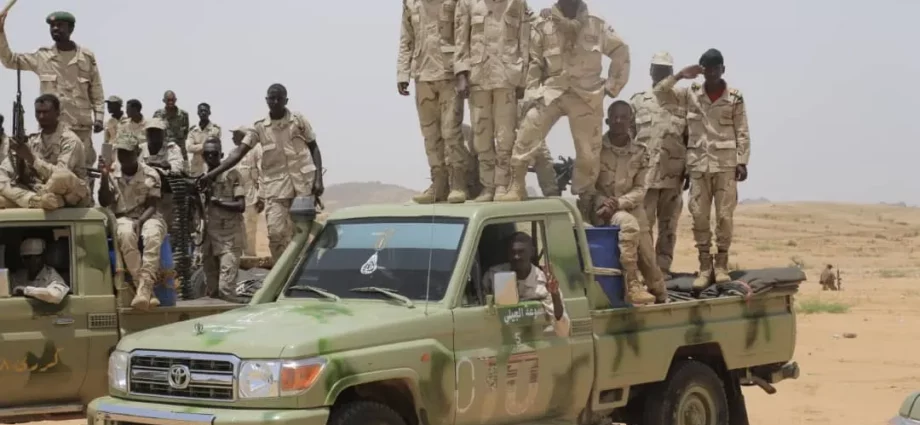
Eyewitnesses told Darfur 24 that Libyan elements participated with the Rapid Support Forces in the attack on the Triangle. They were identified by their military uniforms, combat vehicles, accents, and the flags they carried.
Osman Saleh, a traditional miner, told Darfur 24 that they heard heavy gunfire while they were in the market. It soon became clear that the Rapid Support Forces had taken control of the area after their fighters appeared in their combat vehicles.
He indicated that the joint force of armed movements withdrew from the area at night, accompanied by their families and a number of major traders, headed towards the Al-Khanaq area in Northern State.
The Rapid Support Forces had taken control of the Triangle, located on the Sudanese-Egyptian-Libyan border, in mid-June.
Miners revealed that artisanal gold mining activity in the Triangle region of northern Sudan had ceased after water sources were destroyed by airstrikes.
Mohammed Osman, a traditional miner, told Darfur 24 that gold production in the region had completely stopped after drinking water sources in Jebel Kasu and the Kutum market were targeted by Sudanese army drones.
Osman, an eyewitness who was in the Triangle area when the Rapid Support Forces took control of the area, confirmed that the drones that bombed the area killed eight miners and injured others inside a local club used by youths to watch football matches.
Other miners told Darfur 24 that gold production continued for 33 days after the Rapid Support Forces took control of the Triangle, but it came to a halt after the bombing of the site and the destruction of the only water source, which led to the miners fleeing.
Miners pointed out that most of the gold production is smuggled to Libya and Egypt after being collected in the local mine market. This is due to the high profit margins compared to the Sudanese markets in Al-Khanaq. They noted that the price of a gram of gold before the Rapid Support Forces took control was 250,000 Egyptian pounds, but subsequently fell to 120,000 to 130,000 Egyptian pounds.
The border triangle between Sudan, Egypt, and Libya includes several gold mines, the most notable of which are “Katmt, Qala’a, and Al-Hamra” within Sudan, and other mines located within Egyptian territory, which are operated through smuggling.
For his part, Mohamed Osman, another miner, told Darfur 24 that the Rapid Support Forces (RSF) asked the miners to continue working after taking control. However, a week later, the miners began fleeing toward Egypt due to the looting perpetrated by RSF members at night. He added that the RSF prevented any miner from traveling to the Northern State except through Egypt.
In this context, survivors of the Triangle events who reached Nyala told Darfur 24 that they arrived after nine days on the road. They indicated that the journey from there was via Libyan vehicles until they reached Al-Maliha, with a value of one billion Sudanese pounds, or the equivalent of 10 grams of gold.