Khartoum, July 24 (Darfur24)
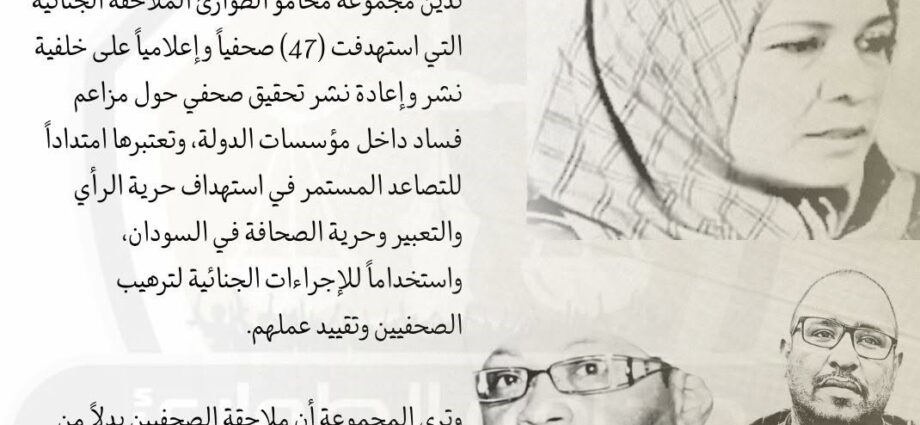
The Sudanese Journalists Syndicate has condemned arrest warrants and legal measures issued against more than 47 journalists in connection with a case before the Cybercrimes Prosecution Office in Red Sea State, pledging legal and union support for those affected.
The Cybercrimes Prosecution Office in Red Sea State issued arrest warrants for the journalists, listing them as fugitive defendants and giving them one week from the date of the announcement to report to the nearest police station to complete legal procedures related to the case.
In a statement, the syndicate said it was closely monitoring the case, stressing its respect for the independence of the judiciary and the rule of law. However, it stated that any legal action related to journalistic work must comply with constitutional guarantees and international standards that protect freedom of expression and press freedom.
The syndicate emphasized that all journalists named in the case are presumed innocent and entitled to a fair trial, including the right to legal representation, adding that no measures affecting their fundamental rights should be taken except in accordance with the law.
It also rejected the classification of several journalists as “fugitive defendants,” noting that some reside outside Sudan and that their whereabouts are known. It warned that the designation could expose them to arrest upon returning to the country.
The syndicate called on judicial authorities to respect the nature of journalistic work and refrain from using criminal legislation, including the Cybercrime Law, to restrict press freedom or intimidate journalists, while stressing that press freedom does not exempt journalists from professional or legal accountability.
A human rights organization also condemned the prosecution, stating that the charges were brought under Articles 10, 23, 24, and 25 of the Cybercrime Law, which relate to privacy violations, defamation, and the dissemination of false information.
The organization argued that prosecuting journalists instead of investigating the corruption allegations raised in their reporting represented “a deviation from the requirements of justice and accountability.” It warned that the case could have a chilling effect on media freedom by encouraging self-censorship and restricting the flow of information in the public interest.
Among those named in the case are former prime ministerial adviser Mohammed Abdel Qader, journalists Ahmed Youssef Al-Tay, Muzdalifa Mohammed Osman, Sabri Al-Aykoura, Ghada Abdel Hadi, Al-Samani Awad Allah, Khader Masoud and Adam Mohammed Ahmed, as well as Al-Walid Fayet Mohammed Ahmed, director of Noon International Company.
Adam Mohammed Ahmed, editor-in-chief of the online newspaper Al-Zawiya Net and one of those named in the warrants, told Darfur24 he learned of the case only after documents circulated on social media and had not been formally notified by the prosecution or any other authority.
He said being labeled a “fugitive defendant” exposed shortcomings in the legal process, arguing that the Cybercrime Law was being used in a manner that served the interests of specific individuals.
Ahmed added that, unlike the Press and Publications Law, the Cybercrime Law allows complainants to pursue proceedings in the absence of the accused and obtain enforceable judgments, describing it as a “rigid law” that undermines due process.