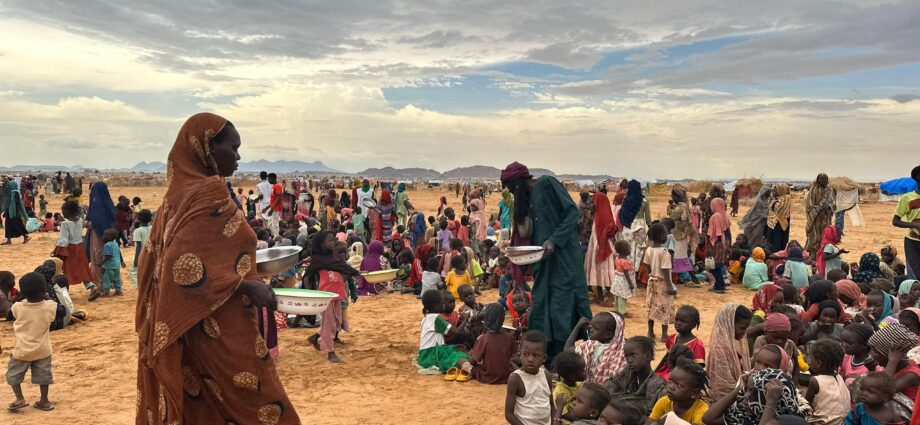
Um Baru, January 21 (Darfur24)
A new humanitarian assessment has found that internally displaced people in Um Baru and Al-Tina localities of North Darfur State are facing a severe and deteriorating crisis in food security, nutrition, health, and basic services amid ongoing conflict and displacement.
The Food Security, Livelihoods and Nutrition Assessment, published on 21 January 2026 by IMPACT, and obtained by Darfur24, shows that displaced households in camps and informal sites in both localities are struggling to meet minimum food needs, relying on negative coping strategies that threaten survival.
The assessment, conducted between December 7 and 29, 2025, found that nearly half of households reported having no food at least once in the month prior to data collection, reflecting fragile food access across displacement sites. Many families reported poor dietary diversity and frequent gaps in food consumption.
Nutrition screening conducted as part of the assessment revealed alarming malnutrition levels: a Global Acute Malnutrition (GAM) rate of 52.9 per cent in Um Baru, and 19.7 per cent in Al-Tina, both above emergency thresholds established by the World Health Organization. Severe Acute Malnutrition (SAM) was also recorded at significant levels.
In addition to hunger and malnutrition, displaced families are facing serious public health concerns. More than half of the respondents reported that at least one household member required healthcare in the two weeks preceding the survey, while many households had unmet healthcare needs due to inadequate access to facilities and services.
Water, sanitation, and hygiene (WASH) conditions were found to heighten health risks, with a large proportion of households relying on unprotected water sources, not treating their drinking water, and practicing open defecation.
The factsheet also highlights that child morbidity is widespread in displacement sites, with many children under five suffering from fever, diarrhea, cough and other leading causes of illness. Access to growth monitoring and nutrition screening services was limited well below international targets, increasing the risk of severe malnutrition and related mortality.
Humanitarian responders have warned that without urgent and scaled up assistance in food, health, WASH and multisector support, the conditions faced by displaced populations in Um Baru and Al-Tina will continue to deteriorate.