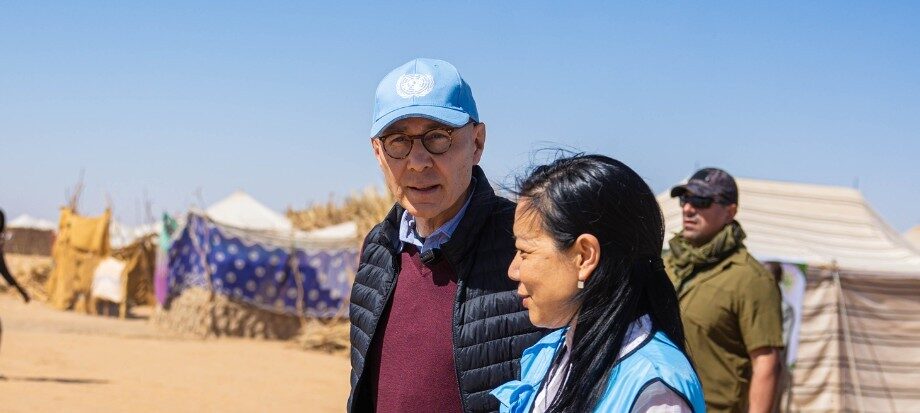
Port Sudan, January 19 (Darfur24)
The UN High Commissioner for Human Rights, Volker Türk, has called on both the Rapid Support Forces and the Sudanese army to immediately halt unjustified attacks on civilian objects, including markets, health facilities, schools, and shelters.
Speaking at a press conference following a two-day visit to Sudan, Türk accused both parties of conducting drone strikes on civilian sites, including schools, hospitals, water facilities, and electricity infrastructure. He said he met residents in Port Sudan, Dongola, Ad-Dabba, and Merowe, as well as first responders delivering aid despite bureaucratic obstacles and risks of arrest and violence. He also met women-led organizations providing legal and humanitarian assistance to victims of war-related abuses.
Türk stated that he visited the Merowe Dam and hydroelectric power station, which he said had been struck by several RSF-launched drones, resulting in power outages at hospitals, disruption of irrigation systems, and reduced access to clean water — conditions that have contributed to the spread of disease.
He warned that attacks on vital civilian infrastructure constitute grave violations of international law and may amount to war crimes. He further stated that sexual violence is increasingly being used as a weapon of war, noting that the UN has growing evidence of its systematic use.
Türk reported receiving accounts of widespread executions carried out by the RSF during the assault on El Fasher, allegedly targeting individuals suspected of links to the Sudanese Armed Forces or allied Joint Forces. He also recounted testimony describing killings of civilians attempting to bring food supplies into El Fasher during the RSF’s prolonged siege, which he said created famine-like conditions.
The RSF took control of El Fasher in North Darfur on October 26, 2025, following a year-and-a-half-long siege and sustained attacks, amid accusations of mass killings, sexual violence, and other abuses.
Türk stressed the importance of accountability for perpetrators of violations, regardless of affiliation, and said his office is documenting crimes in preparation for future legal proceedings. He warned of the risk of similar atrocities in Kordofan, where conflict has escalated rapidly since late October, and noted severe food insecurity and famine conditions in Kadugli, with the risk of spreading to nearby areas, including Dilling.
He added that the proliferation of advanced weaponry, particularly drones, has intensified the conflict, prolonged hostilities, and worsened civilian suffering. “It is shameful to spend vast sums on sophisticated weapons — resources that should instead relieve the suffering of the population,” he said.
Türk also expressed concern over the increasing militarization of society, including the arming of civilians and recruitment of children. He said journalists, humanitarian workers, lawyers, and NGOs face growing restrictions, intimidation, and violence from all sides, warning that the absence of free and independent media fuels hate speech and perpetuates the conflict.