New York, December 23 (Darfur24)
The United Nations Assistant Secretary-General for the Middle East, Asia, and the Pacific, Khaled Khiari, said on Monday that preparations are underway for a consensus document aimed at bringing together the visions of Sudan’s political forces.
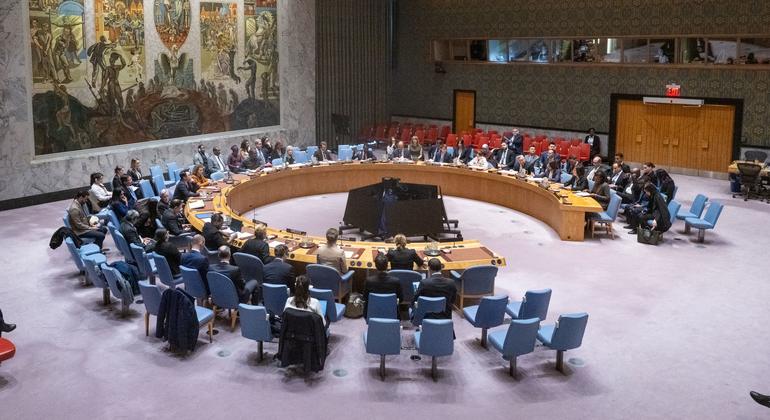
Khiari made the remarks during a UN Security Council session marking 1,000 days since the outbreak of the conflict in Sudan, attended by Prime Minister Kamil Idris.
He said current efforts are focused on supporting an inclusive Sudanese dialogue led by the African Union, which could pave the way for a credible, inclusive, civilian-led political transition. “To support these efforts, the Office of the Personal Envoy is working on a consensus document to consolidate the proposals put forward by political actors and prominent figures in Sudan,” he said.
Khiari also announced preparations for the fifth consultative meeting on strengthening coordination among peace initiatives, expected to be held in Cairo early next year.
He said the UN Secretary-General’s Personal Envoy to Sudan, Ramtane Lamamra, remains in contact with both sides of the conflict to encourage engagement on practical steps to de-escalate violence and improve civilian protection.
Khiari warned that recent developments—including reports of Sudanese Armed Forces withdrawals from Babanusa and Heglig into South Sudan, and the entry of South Sudanese forces to protect oil infrastructure in Heglig—highlight the increasingly complex and regional nature of the conflict.
“If not addressed, these developments risk drawing Sudan’s neighbors into a wider regional conflict,” he warned.
He expressed concern over the growing use of drones by both parties to carry out indiscriminate attacks causing high civilian casualties, and said the continued flow of increasingly sophisticated weapons remains a key driver of the war.
“Calls to stop the flow of weapons have been ignored, and no one has been held accountable,” Khiari said, noting that while the parties were able to halt fighting to protect oil revenues, they have failed to do so to protect civilians.
He stressed that preventing further deterioration and preserving Sudan’s unity and territorial integrity require swift and coordinated action.
Meanwhile, the Director of Operations and Advocacy at the UN Office for the Coordination of Humanitarian Affairs (OCHA), Edem Wosornu, told the Council that “the brutality of this conflict knows no bounds.”
She said the Kordofan states have emerged as a new epicenter of violence, with attacks causing deaths, injuries, destruction, and severe restrictions on humanitarian access. “Over the past year, we have witnessed more atrocities and a deepening culture of impunity,” she said.
Wosornu cited the attack on a World Food Programme truck in North Kordofan on December 5, in which a driver was seriously injured, as further evidence of the risks facing humanitarian workers.
She said humanitarian needs remain immense across Darfur, with efforts ongoing to secure safe access to El Fasher and assess security conditions, amid continued reports of mass killings and sexual violence following the Rapid Support Forces’ takeover of the city.
Humanitarian workers in Tawila, Ad-Dabba, and other areas are struggling to meet the needs of new arrivals from El Fasher due to severe resource constraints, she added.
Wosornu renewed calls for the Security Council to send a strong message that attacks on civilians, indiscriminate violence, and sexual crimes will not be tolerated, stressing the need to protect humanitarian workers and push all parties toward an immediate, comprehensive, and lasting nationwide ceasefire.