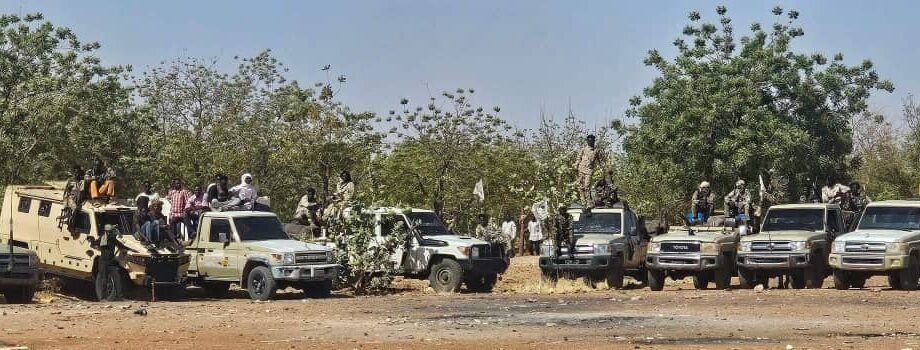
El Fasher, August 7(Darfur 24)
After a year and nearly three months of a stifling siege and hundreds of consecutive attacks by the Rapid Support Forces (RSF), El Fasher, the capital of North Darfur State, remains under the control of the Sudanese army( SAF) and its allied joint force.
The question is, what is the secret behind the city’s long-standing resilience compared to other SAF headquarters that have fallen to the hand RSF in Darfur regio?
Darfur 24 heard accounts from a number of soldiers fighting in the SAF ranks and the joint force about the reasons for El Fasher’s resilience. It also obtained accounts from the Rapid Support Forces regarding the failure of their plan to seize the city.
Zakaria Osman, a fighter affiliatedwith SAF , told Darfur 24, “Our combat doctrine and national motivation to defend our land are what enable us to persevere and repel the repeated RSF attacks.”
He added that most of the fighters are from the city and have no choice but to carry weapons and defend it.
Osman, who was born in El Fasher and joined the SAF in 2006, explained that he has extensive experience with various types of weapons and military tactics, emphasizing his ability to command an entire company in the event of a loss of command during battles.
Social Cohesion
For his part, Yass Abdel Rahman, a fighter in the joint force, said, “The demographic composition and social cohesion among the residents are what gives El Fasher its strength and makes the entire community stand united in the face of attempts to overthrow the city, despite the severe shortages of food, medicine, and drinking water.”
Yass pointed out that the availability of a large number of fighters within the city has allowed for rotation, with each fighter receiving a periodic three-day leave, which helps them maintain their focus and combat capability during the attacks.
He added, “I only serve two days a week, and the position we are defending includes more than 100 fighters , which makes it difficult for RSF to penetrate any front due to the steadfastness of the resistance.”
Hawa Abdullah, one of the female fighters in El Fasher, also spoke about the role of women in defending the city, said that she received weapons training alongside about 200 women and girls over the past year.
Hawa said, “We participate in evacuation and rescue operations, and we secure lines of fire when removing the wounded. El Fasher’s steadfastness is due to the social bond and ethnic composition that distinguishes the city, where everyone participates in its defense without compensation.”
She added that she participated in all the battles, including the most recent confrontation that took place in the southwest side of the city last week, where she fought alongside SAFmembers , the joint force, and popular mobilization forces.
She continued, “When the sounds of clashes are heard, everyone rushes to the fighting positions to support the fronts and fill any potential gaps, and everyone is committed to defending the sector that has been distributed.”
She concluded by saying, “The strength and ferocity of the youth is evident in moments of combat, as they bravely face death, motivated by the need to protect their city and prevent it from falling into the RSF hands.”
The fighters who spoke to Darfur 24 agreed that the main reason for El Fasher’s resilience is their determination and resolve, along with the social unity and community solidarity behind the fighters on the defensive lines.
Determination and Resilience
The suffocating blockade imposed by RSF on El Fasher has intensified, causing the living conditions of the population to deteriorate, leaving most of them dependent on animal feed for their food.
However, Mohamed Adam Kish, head of the Sudan Liberation Movement-Minni Minawi in North Darfur, told Darfur 24 that talk of food shortages in El Fasher will not affect the resolve of the residents or deter them from continuing to resist and defend the city.
Kesh emphasized that such challenges are not an indication of weakness, but rather, in his view, “harbingers of victory” and evidence of the confusion of their opponents. He asserted that the people of El Fasher are strong and steadfast in the face of crises.
He added, “Throughout history, the city of El Fasher has remained an impregnable fortress against those lying in wait, and a destination for all who seek pride and dignity. Its people are united in their positions and capable of overcoming current difficulties.”
He concluded his remarks by emphasizing that “El Fasher will not starve, will not be weaken, and will not be defeated,” sending a message to anyone who doubts this to return to the pages of history.
RSF began besieging El Fasher in April of last year, in an attempt to seize control of the city, where the army maintains its last headquarters in the Darfur region, following its withdrawal from the cities of Nyala, Zalingei, El Geneina, and El Daein in 2023.
A Different Situation
RSF have a different view on their failure to seize El Fasher, after more than a year of siege and successive attacks.
A well-informed political source affiliated with the RSF, who declined to be named, explained that a number of reasons prevented the forces from seizing El Fasher, including “the situation on the ground and the military situation in the city are completely different from other cities in Darfur,” he said.
The source told Darfur 24 that during the period of neutrality between the Sudan Liberation Movement and the Justice and Equality Movement, the Sudanese army was able to bring advanced and sophisticated weapons into El Fasher, including drones that reached the city even before they were used in the battles in Khartoum, according to him.
He pointed out that most of the brigades and military units of the army and the armed movements in the Darfur region were withdrawn and regrouped inside El Fasher after the Rapid Support Forces took control of most of Darfur’s cities, giving the defending forces the advantage of heavy firepower.
The source stated that the leadership of the armed movements had established their headquarters in El Fasher and launched widespread mobilization campaigns that included civilians, many of whom were forcibly recruited under the slogan of “defending land and honor,” according to him.
He accused the armed movements of looting funds from banks and companies in the city and using them to purchase weapons and fortify their military positions, in addition to exploiting the location of foreign organizations.
The source added that El Fasher has witnessed unprecedented fortifications, as containers belonging to humanitarian organizations were diverted.The source concluded by saying that the battle for El Fasher has become a long-term battle of attrition, determined not only by firepower, but also by complex political and military considerations.
Everyone is on alert
For her part, Sergeant First Class Asia Al-Khalifa, a war correspondent for the Sudanese Armed Forces, emphasized that El Fasher’s resilience in the face of the fighting is due to the determination and resolve of the fighters, and their unity on the ground. She noted that “everyone is fighting for victory or dying in defense of the city.”
Asia, the first female field war correspondent in the Sudanese army, explained to Darfur 24 that over the course of two years, she covered at least 225 battles, in addition to daily skirmishes and clashes with the Rapid Support Forces in various directions within El Fasher.
She added that her daily presence at the bases boosts the morale of the soldiers, as fighters say, “If Asia is fighting, why aren’t we?” She said.
She stated that when battles erupt, all residents—women, men, and children—are mobilized, heading to the battlefronts, facing danger despite sometimes even retreat plans.
She noted that the entire city participates in supporting the armed forces by providing water, treating the wounded, and evacuating them from combat sites.
Asia spoke about the details of her Land Cruiser combat vehicle, which she seized from the Rapid Support Forces along with a number of soldiers led by Lieutenant Colonel Ahmed Bayda. She noted that she learned to drive it after the war and makes sure to check it daily.