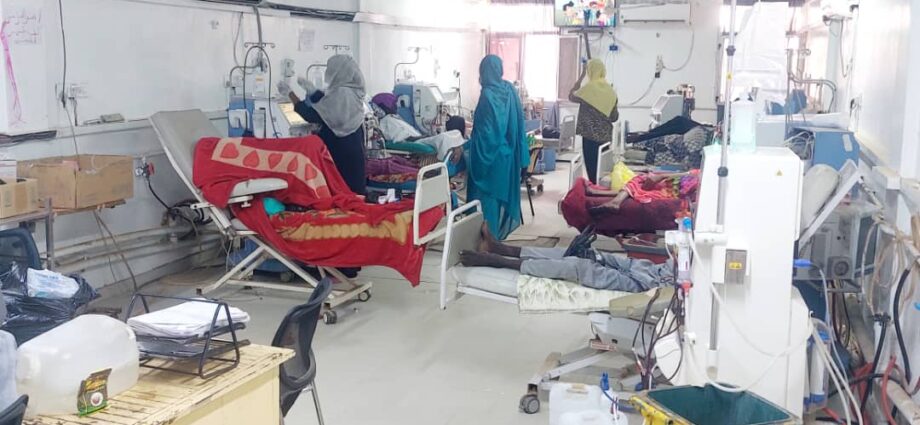
Nyala, July 8(Darfur 24)
In a heavy silence broken by the wailing of patients, hope is stifled at the Nyala Dialysis Center in South Darfur State, where dozens of kidney failure patients face an unknown fate amid broken machines and missing solutions.
In the absence of support and the collapse of the health system, a dialysis session has become a distant dream, while patients’ lives are on the brink of collapse.
A medical source at the Ministry of Health, affiliated with the civilian administration of the Rapid Support Forces in South Darfur, revealed the deaths of more than ten patients at the state’s dialysis center in recent months, due to the malfunctioning of a large number of dialysis machines and a severe shortage of basic medical supplies.
The source stated that the majority of patients are unable to afford the costs of dialysis sessions, which has led to the death of a number of them due to poisoning resulting from the interruption or irregularity of sessions, given the center’s frequent outages.
He added, “The minimum treatment for a patient requires at least one dialysis session per week.”
Patients Rise as Service Deteriorates
The source explained to Darfur 24 that the center is facing a major crisis. Fourteen of the 17 dialysis machines operating at the Nyala Specialized Hospital in the Khartoum Bilil neighborhood have broken down, leaving only three machines in operation.
He stated that four machines require simple maintenance, which can be completed if spare parts are available from the eastern states under army control. Ten other machines require technical intervention from specialized engineers due to serious malfunctions.
He pointed out that patients are forced to purchase dialysis belts for 20,000 Sudanese pounds each, despite their unavailability on the local market and their availability for free in other Sudanese cities.
He revealed a complete lack of other medical supplies, and the high price of intravenous solutions, which cost 170,000 Sudanese pounds per jerrycan on the black market, after previously being provided for free through the Medical Supplies Department.
He continued: “Among the other challenges facing the center are frequent water outages from the main water tank and the high cost of fuel to operate the generator.” Electricity, where the price of a barrel of diesel reached two million Sudanese pounds.
He pointed out that the number of patients increased significantly following the influx of displaced persons from other states, reaching more than 28 patients, in addition to patients from all 21 localities of the state, as well as from Central, West, and North Darfur states.
He criticized the lack of support provided by the civil administration to the center, despite the visit of its president, Youssef Idris Youssef, after assuming office and his pledge to provide fuel, without any positive impact on the patients or the center.
The source appealed to international and national bodies, United Nations agencies, and the Medical Supplies Department of the Federal Ministry of Health to urgently intervene to provide the necessary maintenance for the machines, supply the center with the necessary solutions and medical equipment, and support its medical staff.
Part of the Suffering
Mahmoud Al-Fadil, a relative of the patients, told Darfur 24 that he pays a weekly subscription to provide the fuel needed to operate the center’s generator, in addition to bearing the costs of purchasing the belts and solutions necessary for dialysis.
Al-Fadil called on international and national organizations and philanthropists to support the center, calling for exceptional agreements between the Rapid Support Forces and the army to facilitate the delivery of medical equipment and solutions to the center, considering it an urgent humanitarian emergency. A patient at the center, who preferred to remain anonymous, told Darfur 24 that the patients’ suffering has worsened since the outbreak of the conflict in the country. He pointed to the departure of medical staff, the interruption of supplies of medicines and medical supplies, and the disruption of maintenance of essential machines within the center.
He explained that a large number of patients lost their lives while trying to obtain treatment in El Fasher during 2023, while others died in 2024 and 2025.
The patient called on the civilian administration and the state government in Port Sudan to coordinate and work together to ensure the delivery of basic needs to the center, in addition to sending specialized engineers to maintain the out-of-service equipment.
The Director General of the Ministry of Health in the civilian administration of the Rapid Support Forces in South Darfur, Mustafa Al-Barmaki, acknowledged that more than ten dialysis machines have been out of service without repair since April 15, 2023, confirming that only four machines are still operating, but in a “deplorable” condition.
A photo published on the “Sudan Founding Alliance” Facebook page during the visit of the alliance’s official spokesperson to the ministry, shows that the state’s dialysis center is facing a severe crisis in the availability of necessary solutions, which has led to a significant deterioration in treatment services.