El Fasher, June 26(Darfur 24)
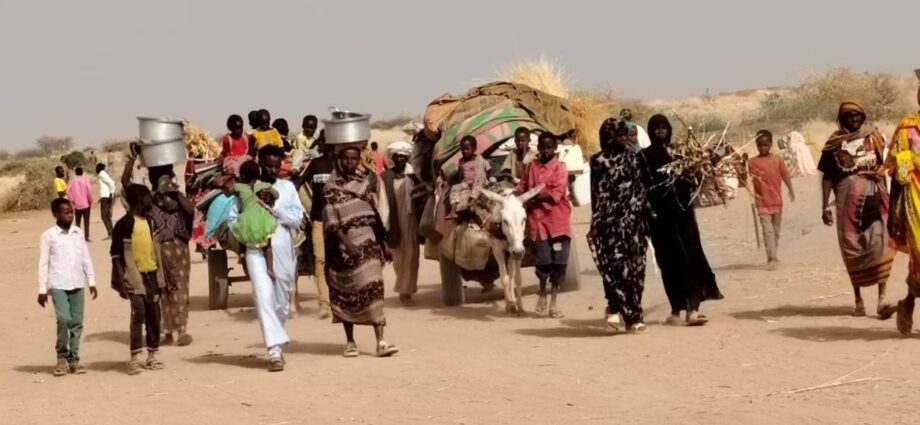
Waves of civilians displacement continue from El Fasher and Abu Shouk camp in North Darfur state, amid escalating security and humanitarian conditions, rising food prices, and a shortage of cash and medicine, according to eyewitnesses and local sources.
The Rapid Support Forces (RSF) have imposed a tight siege on the city since April of last year, attempting to control it as the last major Sudanese army stronghold in Darfur.
A resident of the city, who preferred to remain anonymous for security reasons, told Darfur 24 that he and his family had decided to leave the city next week after the situation had become unbearable, particularly due to the ongoing artillery shelling of neighborhoods, the high prices of food, and the lack of cash and medicine.
He added that residents of the Al-Nasr, Al-Daraja Al-Ula, Al-Shorfa, and Abu Shouk camp neighborhoods had left their homes in large numbers. He added that shelter centers had also witnessed a decrease in the number of displaced persons, especially the Al-Fasher University shelter center, located west of the city and adjacent to the airport. This center is the largest shelter in the city.
In the same context, displaced Safia Adam Al-Nour, a resident of one of the shelters, expressed her desire to leave the center after her relatives had left for a long distance on foot. She explained that her lack of sufficient money to rent a cart to transport her belongings and children was the only obstacle to her departure.
Safia described the conditions inside the city as “catastrophic,” citing the lack of food, a severe shortage of medicines and medical supplies, and a scarcity of drinking water. Overcrowding of displaced people in food distribution centers known as “tekayas” (food centers).
She added, “The ambaz (the leftovers of beans after oil has been extracted from them), which used to be distributed for free, is now selling for 1,000 Sudanese pounds, yet many cannot afford this amount.”
Safiya’s account was consistent with the testimony of another eyewitness, who identified himself as “Abu Yazid,” who confirmed the difficulty of life in El Fasher under siege. He noted the residents’ reliance on the takayas, which no longer meet their needs. He announced his intention to move to the city of Mellit in search of a more stable life for his family.
In a post on his page, volunteer Mohieddin Shogar said on Wednesday that the price of a sack of millet had reached one million Sudanese pounds, while the price of a sack of maize had reached 850,000 pounds. He also noted the lack of medical gauze, forcing some to use mosquito nets to treat the wounded.
On June 12, the governor of North Darfur, Al-Hafiz Bakhit Mohamed, called on El Fasher residents not to respond to calls for help. Displacement, despite the deteriorating humanitarian situation and widespread hunger resulting from the blockade, accused some traders and brokers of hoarding goods and deliberately raising prices.
The governor then announced the formation of a committee to control markets, directing strict measures against those involved in the hoarding. He also gave traders a 72-hour deadline to release stored goods to the market, threatening to confiscate them and distribute them free of charge to citizens. However, the decision was not implemented, and the situation remained unchanged, according to witnesses and local sources.
According to the International Organization for Migration’s Displacement Tracking Matrix, approximately 389 families were displaced from Abu Shouk camp and El Fasher city between June 22 and 24 due to the deteriorating security and economic conditions.
The organization’s reports indicated that these families moved to other locations within El Fasher locality, as well as to areas in El Sereif, Tawila, and El Tina localities in North Darfur, confirming that the situation in the region remains tense and rapidly changing.